
Gentle? Firm?
Or something
else entirely?
Most parenting advice tells you what kind of parent to be. The Regulation Compass tells you what to do in the specific moment you're in.
Like a finger splint for a nosebleed...
That's what parenting can feel like. Not because you're doing too little, but because the good response, reached for at the wrong moment, doesn't work. And you're left wondering why the thing that helped last week made it worse today.
You've got real responses in your kit. Stay calm, hold the line, give space, move in close. Every one of them is right, somewhere. What no one teaches you is how to read the moment in front of you, so you know the right direction at any given time. You need a compass.
That's The Regulation Compass. Not more techniques to add to the pile. The one skill that makes the ones you already have finally work.
Picture the version of you that has this handled.
- It kicks off at the family dinner, and the look the grandparents give you across the table isn't the one you're used to.
- Your kid runs to you now, not just the other parent, when it all falls apart.
- You get the respect and the closeness, without choosing between them.
- The soft version of your kid, the one you see at bedtime, starts showing up more often.
- Your kid still tells you things. And some quiet part of you knows they'll still want to, at twenty-five.
This was never about a well-behaved child. It's about a kid who feels safe, and a home that finally feels steady.
Five movements.
Six practical tools.
No guesswork.
A step-by-step system for reading your child's behaviour and knowing exactly what to do, in the moment it's happening.
This is the system other psychologists come to me to learn. Now I can teach it to you directly.
Start where you actually are.
Answer a few questions and find out your parenting style, plus the one tool that will help you most tonight.
What's your parenting style? or Browse the full courseA MODERN PARENTING TENSION
Pulled between two extremes.
You've tried the gentle approach. You've tried the firm approach. You've read the books, watched the videos, taken the advice your mum swears by.
And still, when your child is screaming at the dinner table, or slumped on the floor refusing to move, or slamming doors at bedtime, you get stuck on what to say and what to do. Should you hold the line or back off? Is this a behaviour problem or a regulation problem? Are you about to make this worse?
Here's what I see constantly in clinic: most parents are co-regulating on pure instinct, with no method. Which means they make the same repairable mistakes on a loop, and then carry the guilt for it. The good news is that is that the solution lies in honing skills and a consistent methodology.TRC has your back with that.
85% of Australian parents yell at their children.
3 in 10 feel guilty every single day.
(National Parenting Pulse Survey)
Not because they're bad parents, but because they're applying the right intention to the wrong moment. A framework that shows you a way to decide in the moment is what’s missing. Until now.
Children need warmth and structure.
Not one or the other.
ONE EXTREME
Authoritarian
Harshness, control, emotional withdrawal.
Boundaries without warmth.
THE OTHER
Permissive
Over-accommodation, collapsing boundaries, fear of ruptures.
Warmth without structure
The complete 5R framework.
The course, the tools, and the systems I use in clinical practice. One enrolment. Yours to keep.
Everything you need to read the moment and choose the move.
When you join, you get the complete system. Not stripped back. Not staged across upsells. The whole framework, every tool, and the supporting materials that make them usable in real family life.
Five movements, each with its own video lessons and a tool you can use the same day. The full framework, taught plainly, by the psychologist who built it.
- The Behaviour Cipher — decode what the behaviour is actually telling you.
- Parenting Like a Pilot — re-establish calm and authority without losing the relationship.
- Elastic Responses + The Silent 10 — respond in a way that de-escalates instead of inflames.
- The Regulation Diamond — match your support to what your child actually needs.
- The 3-Step Reset — repair the relationship after rupture, so the hard moment makes you closer, not further apart.
Every tool as a take-and-keep printable reference card. Print it, stick it on the fridge, keep it on your phone. The framework in your hand for the next hard moment.
Simple prompts that turn ordinary moments into connection. Not for the meltdowns. For everything in between.
The whole framework on a single sheet. The five movements, the five tools, at a glance. For the fridge, for the moment you can't think straight.
The research behind every tool, separated out for when you want to go deeper. Use the tools without it. Or follow the science as far as your curiosity takes you.
Three validated clinical measures combined into a single check-in: your child's challenging behaviour, your stress as a parent, and your wellbeing. You see where things stand at the start, then return to it later in the course to see what's actually shifted. Most parents are too close to the day-to-day to notice their own progress. This is the anchor.
One session. One tool.
The APS recommended fee for a single psychology session is $318. These are the same tools I teach parents who see me privately, and in a session there's usually only time to properly cover one of them.
Here you get all six, for less than the cost of that one session, and they're yours to keep.
To be clear, this isn't therapy and it isn't a substitute for it. What it is: self-paced, in your own time, so you find your way to the tools without a waitlist or an hourly rate. And as TRC grows, you'll increasingly be able to find psychologists certified in the model to work with directly.
The course is $297. Everything else on this page, the decks, the cards, the Clinician's Layer, the Baseline Snapshot, $215 of extras, is included free.
Use the tools. If nothing shifts, you don't pay.
Give the tools a genuine go over your first 30 days. Actually use them, in the real moments they're built for. If you do that and see no change in your home, email me and I'll refund you in full. No forms, no hoops. I can offer that because I've watched these tools work, again and again. The only way to know if they'll work for you is to use them.
Ready to read the moment?
Join the parents who have moved from reacting to leading. The framework is waiting on the other side of the button.
Join The Regulation Compass →Not sure where to start?
Take the free Parenting Style Snapshot. Discover your default parenting style and where the framework can strengthen it. (2 minutes. Instant results.)
For Clinicians — Full CPD-accredited workshop. Learn the complete 5R framework and how to teach it to the families on your caseload.
Not sure where to start?
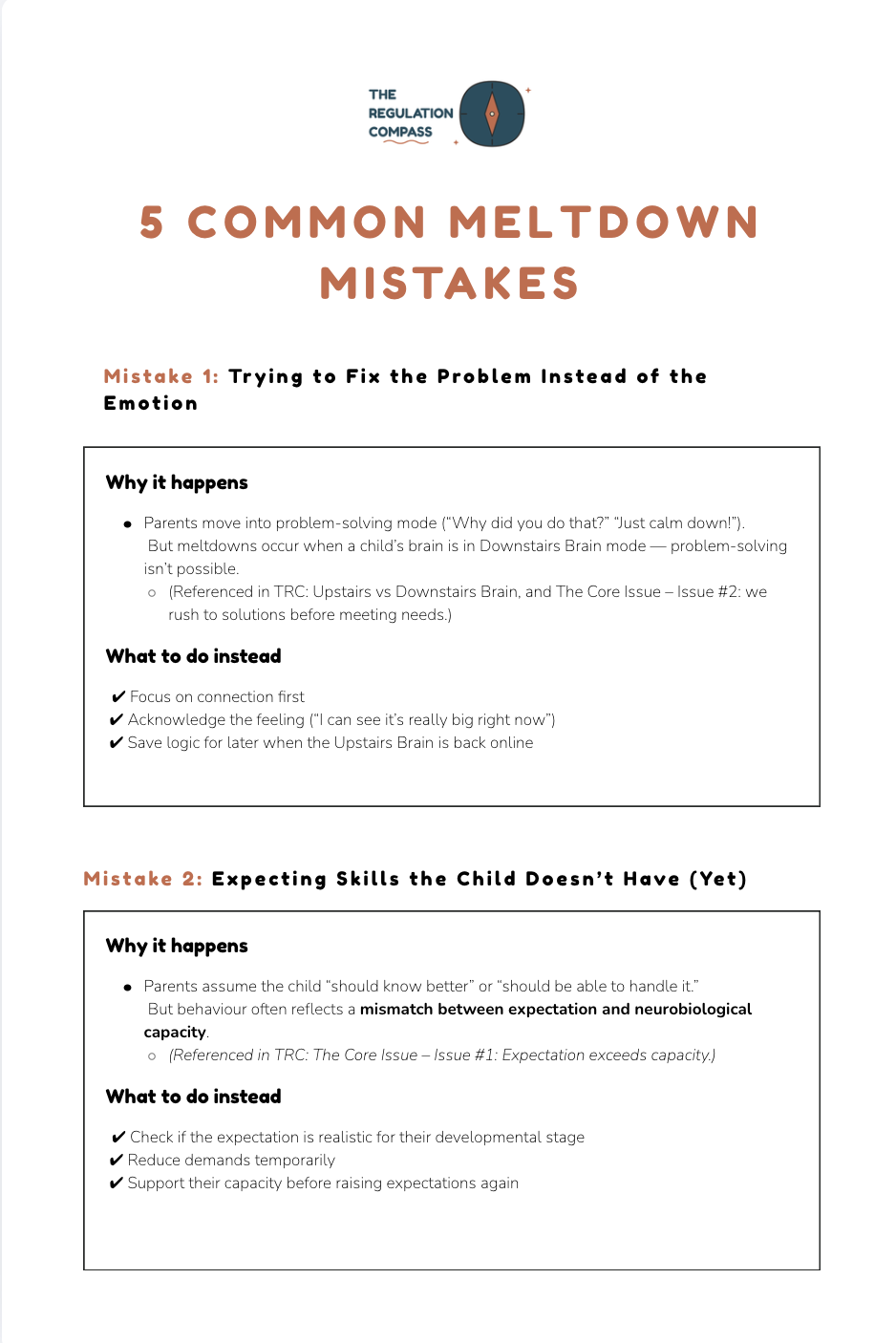
Sign up to the TRC Newsletter and get a free PDF: 5 Common Meltdown Mistakes Parents Make.
Your Questions, Answered
-
Parents of children aged 2-16
-
Around 1–2 hours total, watched at your own pace
-
Recommended but not required
-
In our clinical work we see these techniques used with a very high success rate. That said, Jesse is also available for individual parent coaching to assist with implementation.
-
You can email us at info@theregulationcompass.com.au
-
Yes, each module has additional considerations for neurodivergent children.
-
No. It's an educational framework built from the tools I use in clinical practice, made for parents to use at home. It's not a substitute for individual psychological care, and if your child needs that, this course will help you recognise it.
-
The framework is built on how children's emotional development works, so the principles hold across ages. You'll adapt the tools to your child, and the course shows you how.